Disrupted sleep and sudden bites disrupt households quickly, creating immediate distress for property owners. HarborStone Exterminators delivers systematic bed bug remediation designed to stabilize indoor environments…
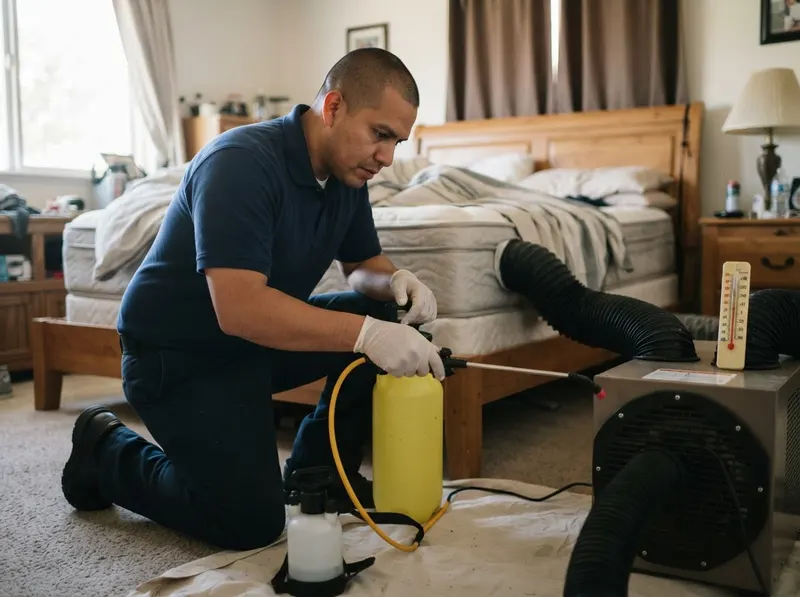
Disrupted sleep and sudden bites disrupt households quickly, creating immediate distress for property owners. HarborStone Exterminators delivers systematic bed bug remediation designed to stabilize indoor environments without long-term contractual obligations. Structural thermal remediation relies on industrial heating equipment to elevate ambient indoor air to lethal thermal ranges, following operational guidelines set by the United States Environmental Protection Agency. Sustained temperatures between 120°F and 135°F penetrate deep inside mattress seams, box springs, hardwood subfloors, and upholstered furniture where nocturnal pests harbor. Because unhatched eggs possess dense protein shells resistant to many standalone contact sprays, forced thermal circulation provides the necessary core penetration to achieve total insect mortality in a single deployment, aligning with standards from the National Pest Management Association.
While thermal treatment addresses open airspace and exposed surfaces, localized chemical applications provide long-term protection against reintroduction. HarborStone Exterminators applies targeted non-repellent formulations and desiccant dusts behind electrical wall plates, along carpet tack strips, and within interior baseboard voids. These applications comply with the standards established by the California Department of Pesticide Regulation to ensure structural safety for family occupants and domestic pets once dried. Residential structures along the San Joaquin Delta waterways experience seasonal humidity that can alter insect harborages, requiring precise placement of microencapsulated residuals. In high-density settings like Spanos Park West, Lincoln Village West, and Country Club, shared wall plumbing chases allow bed bugs to migrate between adjacent rooms, making perimeter barriers an essential defensive barrier.
Selecting between full thermal remediation and focused chemical application depends on infestation severity, room density, and structural layout. Whole-structure heat remediation serves multi-room infestations or properties with extensive furniture clutter where manual spray contact cannot reach every crevice; the primary trade-off involves thorough occupant preparation, including removing heat-sensitive electronics, aerosol containers, and vinyl blinds before technicians arrive. Conversely, targeted chemical treatments suit isolated, single-room discoveries identified during early onset in neighborhoods like Pacific or Miracle Mile, offering lower upfront expense while requiring two to three follow-up intervals spaced 14 days apart to break the insect hatching cycle, as cataloged by the University of California Statewide Integrated Pest Management Program. Technicians evaluate luggage exposure, bedroom count, and baseboard construction to determine the correct pathway during the free visual evaluation.
Structural safety procedures protect residential assets throughout the heating process. Industrial blowers calibrate airflow distribution under the safety rules outlined by the Occupational Safety and Health Administration, preventing concentrated hot spots from warping trim or damaging residential surfaces. In southern Stockton neighborhoods including Seaport and Weston Ranch, as well as master-planned tracts in Brookside and Spanos Park East, multi-story layouts require specialized ductwork routing to distribute thermal energy evenly. For structural pest remediation involving interior building fixtures, protocols follow guidance supported by the California Structural Pest Control Board. HarborStone Exterminators avoids franchise pressure tactics by providing clear diagnostic reports detailing the exact insect concentration, the precise application sites, and straightforward pricing verified on-site before work begins.
Every job gets a firm, written price after a free on-site visit.
For standards, safe disposal, and service guidance on PEST CONTROL SEVICE in Stockton, CA, useful references include U.S. EPA, ENERGY STAR, U.S. Dept. of Energy, Consumer.gov, U.S. Census Bureau, and Google Maps. General consumer and small-business resources are available from USA.gov, Better Business Bureau, FTC Consumer Advice, U.S. Small Business Administration, and Ready.gov.
Tell us about your bed bug heat and chemical treatment job in Stockton and we'll send a clear, written quote, usually the same day.
 HarborStone Exterminators