Stockton properties face relentless foraging pressure from Argentine ants (Linepithema humile), an invasive supercolony species documented by the UC Statewide Integrated Pest Management Program . River delta moisture…
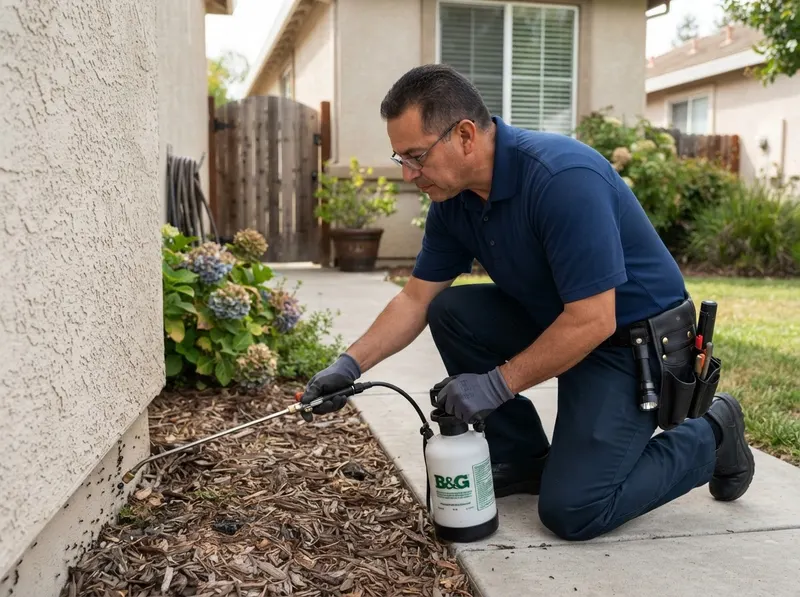
Stockton properties face relentless foraging pressure from Argentine ants (Linepithema humile), an invasive supercolony species documented by the UC Statewide Integrated Pest Management Program. River delta moisture along the Calaveras River, deep clay soils in Spanos Park West, and alluvial silt near Brookside drive colonies subterranean during summer heat and surface-level during winter rains. HarborStone Exterminators isolates the underlying nest rather than applying repellent surface sprays. Standard grocery store contact aerosols scatter workers into a survival response known as budding, multiplying a single localized kitchen trail into multiple breeding queens spread across bathroom vanities, subflooring, and wall framing. Professional intervention utilizes fipronil or indoxacarb micro-dosed baits compliant with standards from the California Department of Pesticide Regulation, which foraging workers ingest and share across the subterranean network via trophallaxis.
Structural geography dictates treatment architecture. Properties in Lincoln Village West and Country Club often feature older crawlspaces and lush shade canopies where odorous house ants (Tapinoma sessile) establish satellite colonies beneath landscape pavers, mulch beds, and patio slabs. For these foundations, field technicians establish a continuous wet-barrier spray three feet up the foundation wall and three feet out along the soil perimeter using equipment certified through the National Pest Management Association. Indoors, treatments focus entirely on non-volatile, target-specific bait matrices placed directly into pipe chases, electrical plate voids, and cabinet hinge mortises where domestic pets and small children cannot make physical contact. This structural barrier approach adheres strictly to the safe water runoff guidelines enforced by the United States Environmental Protection Agency to prevent active compound transit into the San Joaquin Delta waterways.
Larger carpenter ant infestations (Camponotus spp.) encountered near mature valley oaks in Pacific and Spanos Park East require moisture-source mitigation alongside directional void injections. While carpenter ants do not consume cellulose like subterranean termites, their nesting excavates smooth structural galleries inside moist framing, tracked systematically under protocols established by the United States Department of Agriculture. HarborStone Exterminators inspects roofline gutters, window flashing, and sub-slab plumbing entries, providing residents in Weston Ranch, Miracle Mile, and Seaport with direct, contract-free diagnostic reporting. Technicians verify moisture saturation levels using calibrated penetrating meters from the National Institute of Standards and Technology, identifying whether active insect activity stems from roofline condensation or broken sewer perimeter seals.
Every job gets a firm, written price after a free on-site visit.
For standards, safe disposal, and service guidance on PEST CONTROL SEVICE in Stockton, CA, useful references include U.S. EPA, ENERGY STAR, U.S. Dept. of Energy, Consumer.gov, U.S. Census Bureau, and Google Maps. General consumer and small-business resources are available from USA.gov, Better Business Bureau, FTC Consumer Advice, U.S. Small Business Administration, and Ready.gov.
Tell us about your ant infestation control job in Stockton and we'll send a clear, written quote, usually the same day.
 HarborStone Exterminators